
Siansa
This is a competition for traditional music groups. It is run by Gael Linn with the support of RTÉ Raidió na Gaeltachta, Molscéal and Irish Music Magazine, to encourage and give a platform to the best of the country’s young traditional music and singing talent.
- Post Primary Level
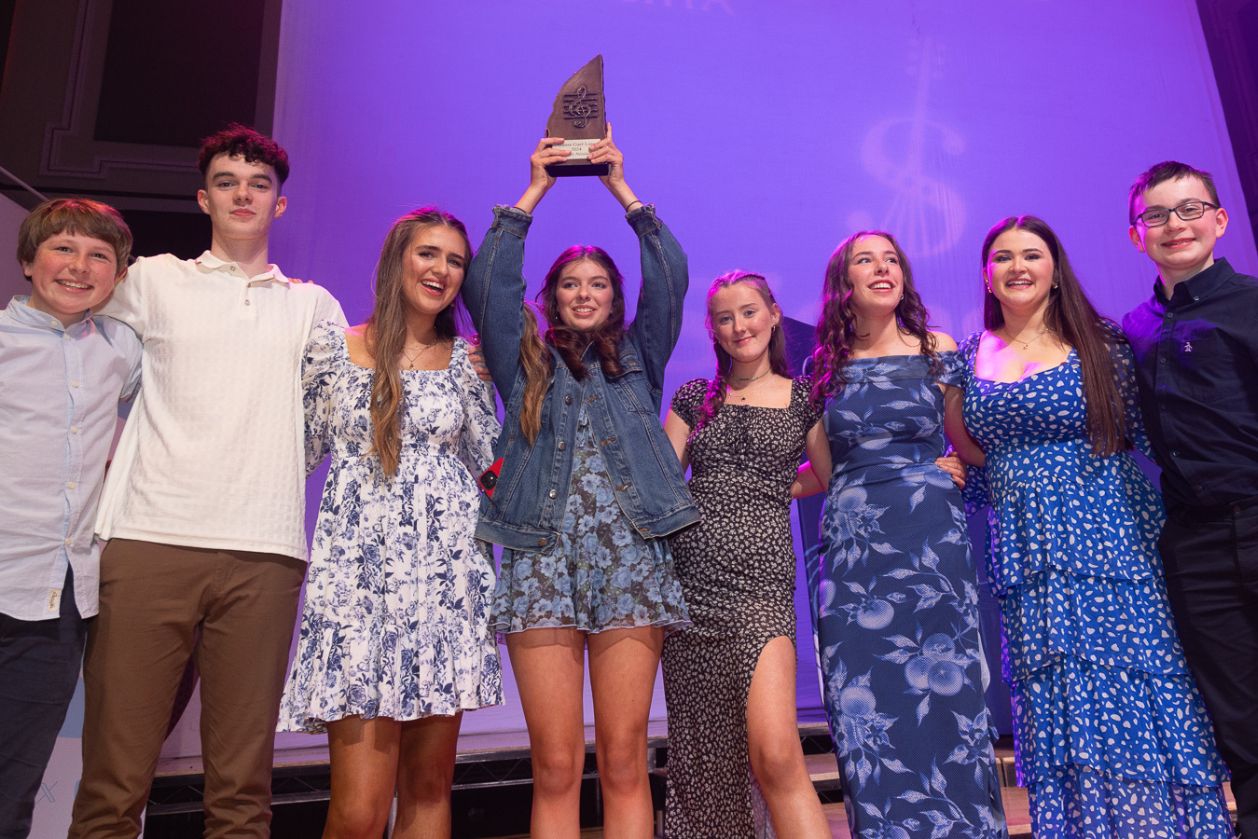
This is a competition for traditional music groups. It is run by Gael Linn with the support of RTÉ Raidió na Gaeltachta, Molscéal and Irish Music Magazine, to encourage and give a platform to the best of the country’s young traditional music and singing talent.
This is a competition for traditional music groups. It is run by Gael Linn with the support of RTÉ Raidió na Gaeltachta and Irish Music Magazine, to encourage and give a platform to the best of the country’s young traditional music and singing talent. Although it is a competition, the young musicians are given help and assistance by organising workshops for them with famous musicians. There is also a great emphasis on the promotion of the Irish language and to this end all events are organised through Irish.
We hope to attract groups whose goal will be to bring traditional music and singing with them, as has been done by groups such as Téada, Altan, Danú and others.
Please read the rules/conditions of participation below carefully, complete the entry form and return it by October 23, 2026. A receipt will be sent to your email address.
Groups are asked to compose a continuous programme or combination of traditional music between 10 and 12 minutes long, with one song in Irish as part of it, imaginatively arranged and recorded on MP3, or WAV.
The deadline for recordings is Friday, 4 December 2026. Following registration, specific instructions will be sent to group teachers/mentors on how to send recordings to Gael Linn. A form will be required to be completed with information about the group at this time, and recordings will not be accepted without this document. (Groups are advised to keep a copy of their recording in case it is lost, or damaged during transfer.
All recordings should be of a high enough standard that the adjudicator will be able to hear and assess the music/singing, but a professional studio recording is not required.
The following must be present:
(a) all instruments must be in tune
(b) there must be a balance of levels between the instruments
(c) the voice(s) of the singer(s) and each instrument must be audible
To create a continuous programme or combination, it is recommended to use various elements of the music – e.g. rhythm, phrasing, notes etc. – to create imaginary connections between the pieces / song.
Music performed in the traditional style (reels, tunes, hornpipes, barn dances, slides, slow tunes etc.) – modernised old music or newly composed music will be accepted. The emphasis should be on traditional Irish music and there should be a balance between this tradition and innovation when the pieces are being selected and arranged.
The song will be considered an integral part of the performance – it is worth 25 marks out of 100. It is worth spending time sourcing and practicing. Old traditional Irish songs (uncommon songs are recommended) with old poems with newly composed tunes, or newly composed Irish songs in the traditional style will be accepted. Translations will not be accepted and the style of the song must fit in with the group’s musical preference.
Click HERE to download additional notes about the song
Playing any musical instrument in the competition is not prohibited (but it is preferable that the instruments are suitable for traditional music)
Dancing will not be allowed as part of the performance – only music and singing will be considered.
It is recommended not to imitate the arrangements of other groups, both professional traditional groups and groups that have participated in this competition before.
A renowned musician will listen to each recording and provide a critique for each group. The groups that have been selected based on their standards to participate in the second stage of the competition, the workshops, will be announced after Christmas. Those that are not selected will be awarded certificates.
Each group selected at the first audition will attend a one-day workshop to be held in four different locations around the country during March 2027 – dates published above. Every effort will be made to arrange central locations, depending on the participants’ location. These workshops will be conducted in Irish only.
The workshops will be conducted by renowned musicians/singers who will advise the groups on various aspects of their performances (e.g. music/song selection, arrangements, accompaniment, vocal projection etc.).
From these workshops, 8 groups will be selected to participate in the Final. (See Rule 7 below). The musical ability, singing and character of the groups will be taken into account when making the selection. Certificates will be awarded to those not selected.
The Final will be held in the National Concert Hall in Dublin. RTÉ Raidió na Gaeltachta will broadcast the event live. Date will be announced as soon as available.
The winners of the competition will be awarded a grand prize of €2,500 and the Gael Linn Trophy.
Those who come in second place will be awarded €1,250 and those who come in third place €750.
All finalists will be awarded a commemorative certificate and medal.
A travel allowance will be paid as appropriate to the groups selected for the Dublin Finals. It will be up to the groups themselves to make their own travel arrangements.
As a guide, the following is the marking system that will be used by the judges at each stage of the competition (but guidance rather than marks is given to the groups throughout)
| Categories | Marks | |
| Rhythm | 15 | |
| Instrumental playing skills/tuning | 20 | |
| *Musical Choice/Arrangement | 20 | |
| Ensemble playing and Performance | 20 | |
| Singing | 25 | |
| Total | 100 |
*see note about musical choice above
Gael Linn will have the final decision in the event of a dispute arising in relation to the definition of rules, conditions of participation or any other aspect of the competition.
1. All discussions with Gael Linn about this competition will be conducted in Irish only.
2. Young people who are over 12 and under 19 years of age on 1 January 2027, will be eligible to enter the competition.
3. Each group must be led by a teacher or adult guide over 23 years of age.
This is necessary to facilitate and ensure the dissemination of information to group members, and also to seek information on behalf of group members from Gael Linn and to provide information about the group to Gael Linn.
Most contact/correspondence will be by email and it is therefore important that the email address is clear on the entry form. The teacher/guide’s personal mobile phone number and email address will not be shared with any third party.
In the event that the nominated guide is unable to perform for any reason, the group would be required to agree on a new person to carry out the duties and provide Gael Linn with the appropriate contact details. Of course, each group may have a music advisor, independent of this person, but all correspondence regarding their participation in Siansa will be with the guide.
4. The selection process consists of three stages:
i. Adjudicator listening to recordings and selecting groups for workshops
ii. Workshops from which 8 groups will be selected for the Final.
iii. The Final in the National Concert Hall.
5. There will be no limit to the number of groups allowed to enter a school/club or other.
6. Each group must have between 6 and 8 members during the competition.
6.1. The members of the group do not have to be in any organisation, school or otherwise together.
6.2. The members named and heard on the recording at 4 i) above will be considered members of the original group.
6.3. No musician/singer will be allowed to participate in this competition except with their original group from the beginning to the end of the competition.
6.4. However, in the event of illness, examinations or the like, or for any other reason, one change, whether that change is permanent or temporary, in the person of the group will be permitted during the entire process.
For example, a new member could be added to the group (where there are only 6 or 7 members in the group already), the number of members in the group could be reduced (but not below the minimum permitted size of 6 members), a person could be removed from the group and a permanent replacement could be added, or a temporary replacement could be added, at a Workshop or in the Championship.
Any replacement, temporary or permanent, or new member must comply with Rule 2 and of course a replacement or new member cannot be added who was participating in the current competition with any other group, even if that other group has withdrawn from the competition at that time (see 6.3 above).
7. Only original groups (see Rule 6) that have qualified through the selection process (see Rule 4) will be allowed to compete in the Championship. In the event that an original group is unable to participate in the final competition for any reason, it will be up to the judges to select a group from the groups that participated in the workshops (4 ii), to take their place.
8. The final decision regarding the winners of the competition lies with the judges and their decision will not be overturned.
9. RTÉ Raidió na Gaeltachta & Gael Linn will have the rights to make the first broadcast of any effort entered. Gael Linn will have every right to record and use the efforts as the organisation decides.
10. Gael Linn will have the right to use images taken at Gael Linn events as publicity material for the organisation in the future, provided that we have obtained prior permission from the group leaders.
Gael Linn has a public liability insurance policy which covers all of our schemes. However, at events organised for school children, Gael Linn is a facilitator rather than a supervisor and each group must nominate a teacher or adult who will be responsible for the safety and supervision of the students (See rule 3 above).
Traditional music is not in danger and the Irish language is not in danger as this young generation emerges.

More information about Siansa
Bláthín Ní Chianaigh – blathin@gael-linn.ie – (087) 345 8428
Gael Linn, 35 Dame Street, Dublin 2. D02 H797